“Things that Make for Peace”
Just how difficult is it for us as Christians to separate ourselves from the weapons-saturated, security-obsessed, war-making culture that we live in? How hard is it for us to love our enemies instead of retaliating against them? How challenging is it for people like us—liberal Christians in progressive churches—to commit ourselves to the never-ending, thankless, often discouraging, and sometimes dangerous struggle of working for peace?
Well, consider this:
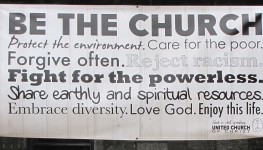
In 1985, the General Synod of the United Church of Christ adopted not one, but two, prophetic positions. In the less controversial of the two actions, the UCC asserted that Christians are called by God to make peace and work for justice, and it encouraged congregations to declare themselves Just Peace churches. The pronouncement included a long list of Just Peace commitments, but in true UCC fashion, left it up to each congregation to decide exactly what a Just Peace designation would mean for them.
The Open and Affirming resolution, on the other hand, was as clear as it was controversial. It called on all UCC churches and conferences to covenant together to be completely open and non-discriminatory toward gay, lesbian, bisexual, and transgender persons in their membership, hiring and ordination policies.
Thirty-nine years later, there are some 1,700 Open and Affirming congregations in the UCC. In some quarters, the UCC is known as “the gay church.” That label is generally not meant as a compliment but we’re proud of it, nonetheless—as we should be.
But when it comes to Just Peace congregations in the UCC, there are fewer than 200. And I haven ’t heard anyone calling us “the peace church.”
“But, but, but . . . ,” you say. “First Church Amherst is both! We became an ONA church and a Just Peace church in the same year—1987!” Surely that speaks well of us.
It does, of course.
But I can’t help but wonder if becoming a Just Peace church in 2024 would mean something very different than it did 39 years ago. I can’t help but wonder if today we’d have a harder time agreeing on what it means to be a peace church than we did in 1987.
Think about it: Hearts, attitudes and polices toward queer folks have changed dramatically in recent years. But when it comes to war, military defense, and violent retaliation? Not so much.
Now, don’t get me wrong; I’m not saying the two things are equal. One of the reasons attitudes and policies toward queer folks have changed so much is that it’s a personal issue. When straight people began realizing that there were people they loved who identified as queer, their hearts and minds began to change and then, eventually, laws and policies and even theologies began to reflect those new understandings. Laws, policies, and theologies began to reflect the love we have for one another and the widening understanding that love is love is love.
Issues of war and peace, on the other hand, can seem distant and disconnected from our daily lives. How many of us know and love individuals in Israel, Gaza, and the West Bank? How many of us know and love people in Ukraine, Russia, Sudan, and Latin America? How many of us have traveled to those places?
How many of us follow the news of those conflicts? Do we read and listen and learn and, like Jesus looking over the city of Jerusalem, weep with anguish and heartbreak? Or do we, somewhat understandably, limit our exposure and avert our attention from ongoing unspeakable suffering?
More telling even than that: How many of us have considered the role our own federal tax payments play in that very suffering and, more broadly, in supporting a culture that puts its trust not in the God of peace and the Jesus way of enemy-love and peacemaking, but rather in the 21st-century versions of Isaiah’s horses and chariots and swords—which, of course, are thousands of times deadlier? When is the last time we marched against war and for peace? Do most of us even know that we have a Peace-builders Ministry Team?
My point is not to berate us for what we do not do.
My hope on this Just Peace Sunday is to encourage us to open our hearts to the pain of the world—not to make ourselves feel bad (though there is a strong argument to be made for lament, mourning, and repentance) but to consider what our faith calls us to do about it.
Some of the harshest words in our scriptures are reserved for spiritual leaders who sugarcoat the way things are:
From the least to the greatest of them, everyone is greedy for unjust gain, God says through the prophet Jeremiah. From prophet to priest, everyone deals falsely. They have treated the wound of my people carelessly, saying, “Peace, peace,” when there is no peace.
Beloveds, let us be clear:
There is no peace for the 2 million Palestinian residents of Gaza. More than 40,000 of them—more than half of those women and children—have been killed in Israel’s war against Hamas and, virtually all those who survive are facing dire shortages of food, medicine, shelter, and options.
There is no peace in Israel, where residents live in fear of terror organizations based in Gaza, Lebanon, and Iran. There is no peace for Jews the world over who face the dehumanization and violence of anti-semitism.
There is no peace in Sudan, where more than 15,000 people have died in an ongoing civil war and more than 8 million people have been displaced.
There is no peace in Ukraine or parts of Russia, where more than 30,000 Ukrainian civilians and hundreds of thousands of soldiers on both sides have been killed.
Military spending throughout the world increased some 7 percent last year and is now at the highest level ever recorded—and yet we are no closer to peace. Between 2021 and 2023, our government was engaged in counterterrorism operations in no fewer than 78 countries—and yet the number of terrorist attacks continues to increase.
“You want to put all your security efforts into weapons systems, military expenditures, and being the world’s greatest supplier of armaments?” God says through Isaiah to the people of Israel. “Okay, then, but I don’t think that’s going to work for you.”
It’s in returning and rest that you shall be saved, God says. Your strength will come from quietness and trust.
But you go ahead and try your way. Meantime, I’ll be waiting to be gracious to you. When you’re ready, I’ll be the strength that you need. I am, after all, a God of justice. Blessed are all who trust me to act and who let me work through them.
God was still waiting to be gracious, still trying new ways to get our attention and earn our trust when God put skin on and became Jesus of Nazareth. At that point, the people of Israel, much like Palestinians for the past 76 years, were living under a brutal military occupation. Israel’s religious leaders had accepted a deal “offered” by Rome: they would be allowed to practice their religion if they kept the so-called peace.
“You want peace?” Rome said. “Just tow the line. Don’t rock the boat. Just sell your souls to Caesar.”
It was enough to make Jesus weep as he looked out over Jerusalem after making his triumphal, boat-rocking entry into the city. He knew the people had made a deal with the devil; he knew they lived in fear and oppression—and for what?
“If only you knew the things that make for peace,” he cried.
If only we knew the things that make for peace.
I wish I could tell you there was a sure-fire formula. But even Jesus couldn’t promise that. But he did teach us about the kinds of trust, the kinds of love, the ways of treating our neighbors and our enemies, the kinds of spiritual practices and transformation that would give us spiritual peace and make peace between individuals, peoples, and nations more likely.
For our own sakes and the sake of the world, Jesus calls us away from war and toward understanding and forgiveness, away from division and toward a beloved community of neighbors, away from demonization and toward love. Jesus calls us to love our enemies, forgive our debtors, welcome strangers and outcasts, feed the hungry, stand with the oppressed, stand up for the suffering, and lift up the lowly.
These are some of the things that make for peace.
Why does Jesus do this? Certainly he knows that evil exists and threatens our safety and well-being. But he also knows that the key to peace—everything from our own inner peace to healthy relationships, anti-racism work, and the peace of the world—is the fullness of understanding of God ’s intention for us and all people, and our willingness to be so healed and liberated by God ’s love that we can become agents of God ’s love and transformation.
We must be so transformed, so rooted in God’s love, and so empowered by God’s Spirit that we can not just deplore evil in all its forms—war, hatred, climate destruction, gun violence, racism, greed—but actively resist it, without becoming what we hate.
Beloveds, what does the way of nonviolent, enemy-love look like in Gaza and Israel? What does it look like in Ukraine? How do we feel about our tax dollars being used to buy bombs and missiles that kill women and children? Is there any avenue for diplomacy in Russia’s war against Ukraine, or do we support a seemingly endless pipeline of money for weapons to Ukraine?
These are big questions about huge problems, and we are but little people. But our great Spirit God lives within us and through us. Our brother Jesus tells us there is a better way, and he calls us to follow him there.
Beloveds, the only way to peace is peace. Let us recommit ourselves to the things that make for peace.