“Spirit for What?”
Numbers 11:24-29
John 7:37-39
Acts 2:1-21, condensed
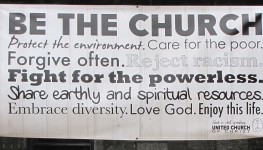
For many years, back before the establishment of the Black Lives Matter movement, the banner that hung over the church’s front porch was a United Church of Christ creation said “Be the Church.”
Below those words in bold, black letters was a collection of phrases in various fonts. They said:
“Protect the environment. Care for the poor. Forgive often. Reject racism. Fight for the powerless. Share earthly and spiritual resources. Embrace diversity. Love God. Enjoy this life.”
On Pentecost Sunday, we traditionally celebrate both the coming of the Holy Spirit and the so-called birthday of the church. That’s all well and good, and on this Pentecost Sunday, I want to invite us to move beyond mere acknowledgement and celebration. Let’s dig a little deeper, and ask ourselves two important questions:
First, a two-parter: What is the Holy Spirit, and who and what is she for?
And second, another two-parter: Who and what is the church for? And what does the Holy Spirit have to do with it?
Never mind that countless books have been written, doctrines debated and adopted, and positions modified and modernized on both questions numerous times over the last two thousand years.
Empowered by the Spirit, surely we can settle things once and for all in the next few minutes!
I’m joking, of course, because—among other things—the point of a sermon is not to settle anything, but rather to open our hearts to the love, blessing, and power of the Spirit. And also because God is still speaking, right? Our role is not to construct definitive answers to God-related questions, but rather to listen for the still-speaking Spirit in our midst—and to keep listening.
With those caveats in mind, I think there is something to be said for asking questions about the Spirit, for continuing to open our hearts and minds to the full depth of God’s gifts, and for constantly assessing and re-assessing how then we are to live—both as followers of Jesus and as a church.
Because it is both a great gift and a holy calling to be human vessels of the Holy Spirit. And it is both a humbling honor and a holy responsibility to be the body of Christ—God’s partners—in loving and healing the world.
And what better time than Pentecost to consider these questions again? What better time to say very clearly that the church and Christians have no special claim to the Holy Spirit? Pentecost may have been the beginning of the church, but it was certainly not the first time the Holy Spirit—the breath and presence and power of God—had been active in the world and on and in the lives of humans.
Our own scriptures tell us the Spirit has been present and active in the world and among all kinds of people since before the beginning.
The Spirit first shows up in the very first sentence of our sacred scriptures:
In the beginning, it says, when God created the heavens and the earth, the earth was a formless void and darkness covered the face of the deep, while a wind from God swept over the face of the waters.
Did you catch that? A “wind from God”?
The Hebrew word for that wind or breath is ru’ah. The Greek word is pneuma. Both terms are expressions for the Holy Spirit, used to convey the breath of life, the breath that gives life and power and makes new life. New life brings growth and change, and change often brings resistance, struggle, or the creation of something we could have never imagined.
Sometimes, as with Moses and the burning bush, the Spirit turns up as fire that does not consume. Sometimes she shows up in prophetic or other unexpected and sometimes beyond-explanation capacities in humans. In the Book of Proverbs, the Holy Spirit is depicted as Wisdom, a feminine presence. Sometimes she is given a name: Sophia. Sometimes, she makes herself known as a still, small voice. Sometimes, as in the story of the church and Pentecost, the Spirit turns up as breath or wind. Sometimes, as in the apostle Paul’s discussion of spiritual gifts, She shows up in the form of individual capacities meant to bless others.
Sometimes, as in our own lives, the Spirit shows up as a kind of knowing. Sometimes she shows up in words that come out of our mouth as if from someone else. Sometimes she appears as a love stronger and deeper and more generous than we’ve ever received or been capable of giving. Sometimes she even shows up in a congregational meeting, working silently and powerfully through hearts and minds to lead us to a decision we never saw coming.
The Holy Spirit, the breath of God, sometimes leaves us all but breathless, saying, “How did that happen? Where did that come from? What is going on?”
Often times, the Spirit comes as a sense of peace in the midst of turmoil. Sometimes the Spirit brings us to a new way of seeing or understanding. Sometimes Spirit gives us the strength and courage to do the thing we were sure we could never do. Sometimes, when we think we can’t do even one more thing or hang on for another minute, it’s the Spirit whose power sustains us and keeps us going.
And always, grace rides into our lives on the wings of Spirit.
The Hebrew prophet Joel foresaw a time in which the gifts and presence and power of God would be poured out on all people—that’s who Peter is quoting as a way of explaining that the disciples are not drunk.
But here’s the thing: Long before Pentecost—at least as far back as when God appointed elders to help Moses lead the Israelites through the wilderness—people have been arguing about who gets the Spirit and who doesn’t, when the Spirit comes, and which things are of the Spirit and which ones are not.
I’m going to stick my neck out here and suggest that those arguments and questions are generally not of the Spirit.
Because we cannot control the Spirit. The Spirit cannot be regulated or limited or doled out only to certain people who believe certain things. (Even the writer or an editor of the Gospel of John seems to get this wrong, qualifying Jesus’s life-giving promise of the Spirit flowing out of our hearts like rivers of living water by putting conditions on the statement that flatly contradicted the Hebrew scriptures.)
The Holy Spirit is a gift of God that, like wind, blows where it wills, when it wills. The Holy Spirit is a holy treasure that, like breath, makes life and new life possible.
So what, then, is the connection between the Holy Spirit and the church? What is the Spirit for, and what is the church for? Why do we celebrate the coming of the Spirit?
Christians and people of other faiths have been asking these questions for thousands of years, and I certainly can’t claim to have any special insight or definitive answers.
But in the hope of encouraging you to consider these questions for yourself, I will share with you some of my thoughts:
The essence of God is a mysterious over-the-top love that gives: extravagantly, indiscriminately, universally, powerfully, and always for the good, healing, liberation, and joy of all people and all creation.
Humans, though made in the image of God, are not God. We are not always loving or giving, kind or forgiving. From generation to generation, humans have hurt one another and abused creation, and the love and wisdom and Spirit of God is forever working to empower us to become who we are meant to be and to clean up at least some of the messes we’ve all had a hand in making.
Jesus showed us the way to live, and the Holy Spirit gives us the capacity to live that way—the way of loving and giving, caring and sharing, forgiving and healing, overcoming everything that separates us and coming together as one.
From the days of an overwhelmed Moses to Jesus surrounded and supported by a small band of followers to 120 people gathered in an upper room to some 3,000 people hearing the word of life spoken in their own language to movements for justice and peace to churches of every size and shape, custom and theology, God has forever brought people together to live out God’s mission of loving and healing the world.
That, in a nutshell, is what the church is for.
On Pentecost—and on every day since, the Holy Spirit said, “I’m here for everyone who will have me. Let’s get busy loving and healing. I’ll be with you every step of the way, and I’ll help you do things you never thought possible.”
“Love one another. Go out together and love the world. I am with you always.”