“Made for Good”
Genesis 3:1-7
Ephesians 2:4-10
Matthew 7:15-20
As with many things, there are pros and cons to choosing a sermon theme and title weeks in advance.
On the one hand, there is the distinct possibility that events will overtake the planned focus of the sermon, rendering it irrelevant or, even worse, explicitly contradicting it.
On the other hand, those same developments might cast what was initially little more than a spiritual lens into sharp, material, relatable relief. More than that, this more concrete and challenging perspective might reveal that there are some truths that are not relative, some realities that are rendered all the more real despite the evidence, and some principles that are both foundational and unchanging.
My charge this morning is, among other things, to assure you that “we inhabit the good world of a good, [loving, and living] God” and that we ourselves are, in fact, made for good.
In a world that is on fire and at war, at a time when the officials of one state are threatening to take transgender kids from their supportive parents, officials of another state want to prevent young school kids from learning that there are gay people, and parents in many states want to protect their children from having to learn about racism, I say this with a straight face and the utmost conviction:
That the God who is love has made us in their image—in love and for love, for partnership and purpose, for beauty and joy, for community and justice, for hope and faith, for growth and for good. That this goodness is our spiritual DNA. That this firm foundation has been laid for us, and that God not only invites us to build our lives upon it but also gives us the lover Jesus to show us how, the transforming Spirit to make new life possible, and real-life tools (also known as the fruits of the Spirit) and community to sustain us along the way.
I’ll admit that I get so excited by this incredibly good news that I’m tempted to shout out, “Come on! What are you waiting for? Let’s make some good!” like the most insufferable tour guide ever.
And I’ll confess that, maybe like you, sometimes I feel so heartbroken and discouraged by the evil and brokenness in the world I have a hard time believing in all this goodness.
Believe me, I get it. I understand that it can be really hard to trust that we are made for good when other human beings—every single one of them a beloved child of God also made for good—are at this very moment killing Ukrainian civilians as well as combatants, and shelling and destroying hospitals, residential buildings, and supply lines of food and medicine.
I have dear friends who had to schedule a Zoom call with their son and daughter-in-law—people I know and love—to discuss whether, given Vladimir Putin’s apparent willingness to use nuclear weapons, they and their four children will remain in Hungary (where they live) or leave Europe altogether. I mean, what kind of world and what kind of people create situations in which families have to prepare for the possibility of nuclear annihilation?
Made for good?
It’s enough to give me some empathy for the writers of the Judeo-Christian creation story, who must have been trying to make some sense of a world in which bad things happened to good people, and famine, natural disasters, and evil rulers were common. And so they came to believe that the first humans really messed up, that they chose knowledge over wisdom and autonomy over partnership with the divine, and that God had been punishing humanity every since.
It’s almost enough to make me forgive the Christian theologians of the fourth century who came up with the idea of original sin, as well as the countless theologians, priests, pastors, and others who have built entire churches and schools of thought on the premise that we are born bad and must spend the rest of our lives making up for it, people who have the gall to make good people question whether they are worthy to receive Communion—when Jesus himself shared the bread the cup with his betrayer.
I mean, had any of these “made bad” people ever held a baby? Had any of them ever loved someone so much that they would do anything—anything—for them? Had they never seen people give of what little they had to help someone else? Had they never seen people come together to work toward a common goal? Had they never been moved to tears by a poem or a piece of music, or been inspired to generosity and sacrifice by the raw need of another? Had they never felt their closed hearts opened up by love?
Have you?
Of course you have, because you were made for good and you live in a good world. Of course you have, because you were made worthy and good by the very Epitome of Good, and you are called to live out your inherent goodness by the Good Word Made Flesh. Of course you have, because whatever hardships and injustices you have known, you have lived in this achingly beautiful world among people who love you.
Take a moment to recall a time when you felt your own goodness or when you were moved by the goodness of others or some good that was done when you and other people came together.
[pause]
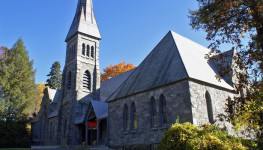
Just in case nothing is coming to your mind, let me mention that it was a year ago today that Lucio Perez walked out of this sanctuary church with a stay of deportation in hand, something your goodness and God’s grace helped make possible.
Now, to be perfectly clear: The fact that we are made for good doesn’t mean that we should just do whatever we want. Our being made for good in a good world doesn’t mean that we don’t care about others or work to make the world a better place. But it’s knowing that we are made for good that inspires us to live into our greatness. I fall short of the glory of God at least 10 times a day—and I know it because it just doesn’t feel right; I know I’m created to be and do more than that.
Which brings us to Paul’s letter to the Ephesians, in which he reminds those good people that they have been delivered from brokenness and limitation by grace and through faith and that God’s grace does not depend on how good they are or how many good deeds they do; it is pure gift. And in the next breath, he says, For we are what God has crafted, created in Christ Jesus for good works.
And ever since then, and maybe even before that, many humans who were made for good have worn themselves out doing good. We have needed to prove to others or ourselves that we are good. We have operated from the false belief—promulgated by our self-help culture at least as much as religion—that whatever our problems, we can work our way out of them, and that we really can have our best life if we just have perfect children, buy the right stuff, read the right books, listen to the right podcasts, and do all the things.
In Christian theology this is called the grace versus good works question, or sometimes faith versus works. And, as with most things, it’s not an either-or but rather a both-and. We are saved by grace, not works, and yet we were created in Christ Jesus for good works. This is not about doing good to earn God’s favor or doing good works to prove that we are good; it is a natural outflow of our inherent goodness, the manifestation of who were were created to be.
Our experience of grace inspires us to goodness, and the good news of our faith—that we were made not for war but for peace, not for division but for partnership, not for evil but for good—motivates us to share that goodness with a hurting world.
We are like trees planted by streams of water, that yield their fruit in its season, and their leaves do not wither. We are like trees, which don’t so much “do” good works or produce good fruit but rather simply be. Their being involves staying grounded in the nourishing soil and opening and reaching for the light of the sun. All they need is given to them, they simply receive it, take it in, and let it do its good work in them so that they can do their good work in the world.
Are we any different?
Stunned by the photograph of Vladimir Putin sitting at one end of a very long table, opposite the French President at the other end, the poet David Whyte wrote a poem a couple weeks ago called “There Is No Table Long Enough.” It reads, in part:
There is no table long enough
to keep us from our own unspoken darkness
but, thanks be to God, and every power
beyond us, there is no table long enough
to hold the riches of darkness transformed,
to hold the wine raised and the bread
consumed, to hold every item of our shared bounty,
brought from every field of our endeavour,
in a promised future, that despite ourselves,
will always be destined to forgiveness.
There is, beloveds, no evil or war, no power or circumstance that can separate us from the love of God. And as long as we are grounded in God’s love and goodness, there is nothing that can separate us from our own God-given goodness.
We are made for good, so let us be good.