“Higher Power, Deeper Peace”
Acts 2:1-21
It’s very rare that I put a sermon title in the bulletin—and not only because I often lack a title until long after the bulletin has been printed, and sometimes even after I’ve finished a sermon.
You see, I never really know which way a sermon is going to go or what it will say until I’ve open my heart and mind to the Spirit (again) and trusted that in writing a sermon I will encounter God again and be given something to say.
Holding off on a sermon title and theme is, for me, an important way of getting out of the driver’s seat and inviting Spirit to take the wheel. And, if truth be told, it’s also a way of avoiding boxing myself into a corner because, more often than not, when I do settle on a sermon title or theme, the Spirit is sure to lead me in a different direction.
I give you this insight into my spiritual practice of sermon writing to let you know that I did not choose this sermon title lightly. I chose it based on what I hope was the prompting of the Spirit and with the awareness that it might limit me—and/or the Spirit—but that I wanted to explore some new and different territory this Pentecost Sunday.
Oh sure, I could have gone with the common “birthday of the church” theme. Or I could have, as I’ve done in many previous years, gone all out to highlight the dramatic and empowering ways in which the Spirit of God—the very breath of God that lives within each of us—lives and moves in the world.
After all, the time is always right to remember that before the Holy Spirit was poured out upon a relatively small group of Jesus followers—a group similar in size to ours here today—they had spent 50 days huddled together in confusion, fear, grief, and uncertainty. But after they were filled with the Spirit, after they were transformed by a Higher Power, they left their fear and isolation behind and went out into the world with Spirit power and holy love.
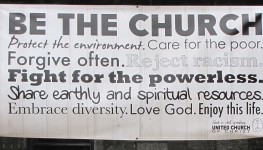
And so the church was born. The church was born—as the Salt Project says in one of the best descriptions I’ve come across—“as a dynamic community of people following Jesus, empowered by the Spirit to carry out God’s mission of healing, liberation, and joy for the sake of the world.”
Let me say that again: The church was born “as a dynamic community of people following Jesus, empowered by the Spirit to carry out God’s mission of healing, liberation, and joy for the sake of the world.”
From the very beginning, the church was “diverse, inclusive, and egalitarian.” If only it had stayed that way throughout history. If only the church had remained a Spirit-led community instead of becoming a state-sanctioned religion.
And yet the Spirit has never left the church. The Spirit has never stopped being available to us as powerful guide, advocate, comforter, healer, source of renewal and restoration, and—last but not least—spiritual force that transforms us, the church, and the world. The Spirit has always been the very breath of God living, moving, and acting in us and in the world.
Pentecost Sunday simply invites us to remember that if we let her, the Spirit will show us the way to go and give us the spiritual gifts we need to get there. Pentecost Sunday, if we let it, can encourage us to let Spirit take the wheel. And Pentecost Sunday, if we’re willing and paying attention, can invite us to consider who and what the church is called to be in this time and place, in our time and place.
And while there is a good argument to be made (or, more appropriately, a question to be discerned) that our current political and social situation calls us, like the very first iteration of the church, to go out into the world with boldness, clarity, and radical and inclusive compassion, I can’t help but wonder if the Spirit might also be calling us to offer to our community and the world something more inviting, more quiet, and more healing.
In short, I wonder if the higher power of the Spirit might be calling us to offer a deeper peace to a nation and a world at war. I wonder if Spirit power might be inviting us to become a place of deep peace for people divided not only from one another but also from themselves. I wonder if Spirit might be leading us to become a source of deep grounding and peace for a world that is on fire in more ways than we can count.
I have been wondering this for some time now. To be fully transparent, I will tell you that it is a wondering born not only from contemplative prayer and other spiritual practices but also from a certain fatigue and disillusionment with the world’s ways of resistance.
And, before I say another word, let me be clear: I will always believe strongly that, in the words of the great prophet and biblical scholar Walter Brueggemann, who died last week, “The prophetic tasks of the church are to tell the truth in a society that lives in illusion, grieve in a society that practices denial, and express hope in a society that lives in despair.”
To review, Brueggemann says the church’s prophetic tasks are to tell the truth about what is happening, grieve the evil and injustice that our society ignores or denies, and to provide clear and strong hope to those who have lost any hope that things can be different and better than they are.
Thanks be to God, we’re all pretty clear, I think, about the importance of living out those prophetic tasks.
Where we get confused, I think, is in separating prophetic action from spiritual practice, in thinking that being prophetic is something we do together out there, while being spiritual is something we do on our own or, perhaps, together in here on Sunday mornings.
Beloveds, the good news of Pentecost is that the Spirit is in all of it! The good news of Pentecost is that powerful, prophetic, healing and hopeful action is grounded in and powered by faithful spiritual practice.
The Spirit’s Pentecost charge is to open ourselves to being transformed and healed by the Spirit in all her ways. The holy charge of Pentecost is to allow the Spirit to work in us and through us in such a way that everyone hears the good news of God’s healing, grounding, liberating love in their own language.
I realize that everyone doesn’t speak the language of connecting to God through spiritual practice—and I say that as someone who works hard to learn, practice, and teach it. I also realize that not everyone speaks the language of political resistance or the language of justice and peace work or the language of generosity or the language of community.
But all of us—everyone, everywhere—were created in the image of God, and while that image is made of many things and the Spirit speaks many languages, her primary language, I think, is the language of connection: connection to the Spirit of God within us, connection to the Spirit of God in every person and all living things, and connection to the Spirit of God in creation.
Unfortunately, we live in a world whose primary languages are separation, domination, greed, and scarcity. Those languages are so loud, powerful, and pervasive that much of the time we cannot hear anything else. Much of the time we fail to hear the cries of our own hearts for connection and peace. Sometimes the languages of hatred, division, and enmity are so loud and overpowering that we don’t even realize our God-given language has been silenced and repressed.
Sometimes we use our God-given native language so rarely that we all but forget it. But the Spirit knows, and the Spirit of God is always within us; we need only open our hearts and minds and listen to her voice. We need only give her permission to lead us.
The church, if it is doing its God-given, Spirit-driven job, speaks the language of love and inclusion, the language of peace, the language of holy connection and community.
And so it is that on this Pentecost Sunday—when National Guard troops have been summoned to the streets to take military action against the people of this country—I wonder if we shouldn’t devote ourselves more intentionally, as individuals and as a church community, to speaking and sharing the Spirit’s primary language.
This wondering began to take root in me as I listened to another of the Spirit’s languages: the language of art. This desire was awakened in me because I went to church last week—and, both sadly and wonderfully, I had that holy, church-like experience in an art museum.
Time prevents me from giving you a full description of the artist Alison Pebworth’s “Cultural Apothecary” exhibit at Mass MoCA. But I can tell you that the exhibit—which included invitations to drink tea, connect with our feelings, connect with our dreams, connect with others, and to connect with what ails us so that we might cure it—felt to me like the church we need to become:
A safe place where troubled souls can find extravagant welcome and deep peace. A prophetic place where marginalized people can find sanctuary, respect, and community. A holy-ground place where disconnected people can re-connect with God, their own hearts, and the needs and gifts of others. A Spirit-filled place where every language is respected and we all focus on learning and living the Spirit’s love language.
We can also take our Spirit peace out into the world on our own. Without the need for (or the benefit of) congregational discernment and consensus, each of us can leave here today in the higher power of the Spirit, newly committed to being an instrument of deep peace for the people in our lives, for our community, and for the world God so loves.
As it turns out, there is no risk in choosing a sermon title like “Higher Power, Deeper Peace.” Because Spirit power is always present with us and available to us, and deeper peace is both a gift and a fruit of the Spirit.
May we know both power and peace. May we, as individuals and a church, be instruments of holy power and transcendent peace. May we, on this Pentecost Sunday, tell and live out the truth of the Spirit power we’ve been given. On this Pentecost Sunday and every day, may we embody the hope of the Spirit by connecting with the Holy in all people and things and making deep, lasting peace.