“Dreaming God’s Dream”
Isaiah 65:17-25
Mark 6:30-44
Michael Jr. is a comedian who cares about a lot more than making people laugh. His jokes are good, and laughter is medicine, but what he’s really trying to do with his comedy is help people get beyond the what of what they do to the truth of why they do it.
In one appearance he engages with a man who identifies himself as a music teacher. Michael Jr. invites the man to sing a verse of “Amazing Grace.”
The man has a beautiful baritone voice, and he sings the hymn from memory just as if he were singing from a hymnal. The audience applauds politely.
Then the comedian invites the man to sing “Amazing Grace” as if his uncle just got out of jail and as if he had been shot in the back when he was a kid. “Sing me the ‘hood’ version,” he tells the man.
What follows is a breathtaking, heartfelt, powerfully moving and gorgeous rendition of the hymn that gets the audience members up on their feet, clapping and weeping and cheering with joy and awe.
When the comedian recovers, he turns to the audience and explained to them what they had experienced. “When you know your why, your what becomes more impactful,” he said.
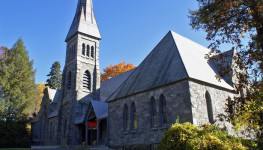
When it comes to giving, to pledging a portion of our income to this church, it’s easy to focus on the what. We can talk about our hard-working staff, our impactful ministries, the upkeep of our historic building, our outreach to our community, and our generosity to the world.
That is all well and good, and . . . this morning I want to invite us to also consider why we give of what we have to God through this church.
We are, of course, supposed to give. We are supposed to share. But I’m not talking about obligations or guilt. I’m not even talking about what God tells us to do or how much Jesus talks about money and giving.
I want to suggest that we give because we want our gifts to make a difference—not only to this church, but also in the world.
We give because God is not only the creator of all that is good but also because God is the repairer and restorer of all that is broken. We give because God has dreams for us, this world, and all creation.
And because we are made in God’s image, we are dreamers, too. We can’t help it; it’s just who we are and how we’re made. Because of that we can’t stop hoping and working for justice and peace; we can’t stop welcoming the stranger; we can’t stop trying to be agents of healing; we can’t stop trying to build beloved community; we can’t stop trying to ensure that everyone has enough.
It’s all there in Isaiah 65.
The Creator, seeing the human-caused suffering of creation, dreams of a new creation, one in which everything will be as it was originally intended. In this new creation, no lives will be cut short by violence or disease, there will be no stress or grief, workers will enjoy the fruits of their labor, people will live in harmony with their God and their neighbors, and even the animals will respect one another and live in peace.
God’s dream is the Beloved Community writ large, something more like the Beloved and Loving Creation, a place where everyone has enough and no one—human or animal—hurts another.
It is outlandish, of course.
And . . . it is what Jesus meant when he said the realm of God was near. It is what Jesus aimed to bring into being through small bands of people who, transformed and empowered by the very Spirit of God, would learn on the job. By dreaming God’s dream and being God’s love for the world by living together and sharing with each other what they had, they would come to see more clearly their own shortcomings and those of their neighbors, they would disagree about what was true and argue over the best way to do things.
But in the process of living out all their humanity in close proximity to God’s love and their neighbors, they would also come to know the love, goodness, healing, and abundance of God.
They would come to know themselves forgiven, with a second chance around every corner. They would come to know one another not only for their annoying habits but as revelations of the living God. They would come to marvel at what wondrous works the Spirit could do through such a ragtag band of people living under challenging circumstances. They would come to discover that while political and financial power is fleeting, the power of love is boundless and timeless. They would discover that living for others was more fulfilling than living only for themselves. Over time, as they remembered how far they had come by faith and with one another, their fears would fall away and they would live by love.
Those early Jesus followers knew their why. They were dreaming God’s dream. One person, one need, one act of love, one life changed, one faith community at a time, they were building a new and better world—with God and one another.
Which is not to say there were no growing pains or destructive teachings. Which is not to say that once they got past the barely-making-ends-meet stage, they didn’t sometimes forget the people without enough to eat or a place to call home. Which is not to say that once the church was institutionalized and got a taste of power, it didn’t lose the thread of grace and mercy or the call to extravagant welcome and radical generosity—for generations and centuries at a time. Which is not to say that, even when the church recovered the thread and renewed its efforts to make God’s dream real, it didn’t sometimes get distracted by the latest spiritual fad, the newest promise of financial security, the steady decline of church membership, or—just as likely—a crumbling building, a world on fire, endless meetings, or a discomfort with faith.
But the dream never went away; the dream never will go away. And because systems of power, greed, and cruelty have yet to come to an end, the world continues to need loving dreamers committed to God’s dream. The world needs churches that will first imagine a different future, then work to live it out among themselves, and then take it out into the world. We need churches that will stand with all who suffer and then form, inspire, organize, and support people who will change the world with God’s love, people and churches who will—by God’s Spirit—resist the powers and transform the systems that cause the suffering.
From time immemorial, humans have considered their dreams and God’s dream and all the world’s needs but had trouble imagining how there was any hope of healing the world and making those dreams of justice and peace a reality.
One of the church’s jobs has always been to remind us that everything we do in faith matters. We must remember why we keep working at being the church—not just because our friends are here, not simply because we like the music, not only because it’s a respite from the cruelty of the world, but also because we love this beautiful and broken world and we have been called to bring God’s love into it. We are here, still trying to be the church, because we trust that every step we take together, every act of love we make together heals us and brings us and the world closer to beloved community.
Jesus’s disciples could not imagine feeding a crowd of 5,000 men—plus women and children. It was impossible, they told Jesus.
But Jesus knew otherwise.
How much do you have? he asked them.
And then, when they scrounged up nothing more than five loaves and two fishes, he didn’t say, “Is that all?”
Rather he took it, gave thanks for it, broke it and shared it.
That’s how the impossible becomes possible. That’s how dreams get fulfilled. That’s how everyone gets enough and more than enough. That’s how churches not only survive but thrive:
When everyone gives some of what they have for the welfare of all.
It sounds so simple, doesn’t it?
And yet some of us are already thinking about why we can’t increase our pledge to the church this year or why we can’t give at all. I get that. I know times are hard and uncertainty makes us hold onto what we have all the tighter.
And . . . I know you believe in the dream. I know for a fact that, as sure as the sun will rise tomorrow, you believe in working for a better world, a world where every life truly matters, where everyone is safe and loved and we all look out for each other.
The world needs transformed people, and our church—by God’s love and through God’s Spirit—is a place where grace and healing happens, where people find love and acceptance and purpose and then become more loving and accepting and purposeful.
Both our church and the world need dreamers and planners, lovers and healers, bridge-builders and peacemakers, people who have been so thoroughly transformed by God’s love that they want other people to experience the same grace, healing, hope, and joy.
How much is God’s dream worth to you? How much is this church community worth to you?
Our gospel story tells us no gift is too small, so please don’t let your financial circumstances make you think that your modest pledge won’t make a difference. Trust me, it will—just as the small bites offered by the poorest Jesus follower among the five thousand contributed to hearty meal and a boatload of leftovers.
“Go see what you have,’ Jesus says, “and then bring it to me.” Our gospel story also tells us that no dream is too big. If we can imagine it, if we give ourselves to it, if God blesses it and shares it, there is no telling what previously unimaginable things will happen.
Small, big, or somewhere in between, our gifts will be blessed and shared. So let’s all give as much as we can to make this church a vital part of God’s dream for the world.