“Be Better”
Luke 4:14-30
Some of us aren’t the least bit interested in the Bible—because we think it’s not relevant in the modern world, because of the ways it’s been used against people like us, or because—for whatever reason—we think it’s not worth our time and energy.
I get that, too.
But then we come across stories like the one we just heard, in which local boy makes good, which makes the locals proud, but then local boy starts saying that God’s freedom and justice and healing and abundance are poured out for everyone, which makes the locals want to kill him because they consider themselves special.
At first glance it might seem like just another weird Bible story that leaves us scratching our heads. We might use it as just the latest example of how irrelevant the Bible is.
I mean, come on: Our government has been taken over by a few super-rich white men whose first order of business is to protect their privileged entitlement by trying to keep anyone but people just like them from getting any of the stuff they believe belongs only to them.
What in the world could our Bible story possible have to do with—
Oh.
Wait a minute.
Yes, there is that part in the story where Jesus seems to suggest that non-Israelites—starving widows and diseased enemy military officers among them—are also beloved of God. There’s that part of the story where Jesus seems to be saying that God’s mercy is wide enough to take in all people and all creation. And he does imply that God’s very best news is for the poor and oppressed.
But what does that have to do with—
Oh.
In addition to a line from elsewhere in our scriptures—something about “nothing new under the sun”—a certain song title comes to mind, “Same As It Ever Was.”
Then there’s that movie; I think it was called “The Empire Strikes Back.”
Now, don’t get me wrong: I’m as heartbroken, angry, worried, discouraged, scared—and occasionally apoplectic—as many of you are. The last thing I want to do is to discount the seriousness of our situation as a democracy, or downplay the very real suffering being imposed on huge numbers of people all over the world, from our immigrant neighbors to our transgender siblings, our BIPOC siblings, federal employees, and hundreds of millions of people in this country and the world over who rely on programs funded in part by the United States government.
It is, in fact, all that short-sighted, needless cruelty, greed, and exclusion that has me and so many of us feeling so heartbroken, angry, scared, and occasionally apoplectic.
But . . . I’m guessing none of us came here this morning for political analysis. And, as easy as it would be for me to rant about all the horrible things being done by the new administration, as easy as it would be for me to talk about how dangerous these policies and pronouncements are, I’m guessing you didn’t come here for that, either.
We already know that, and we’re not sure we can take any more ranting.
What we come wanting from God and one another this morning is to know that we’re not alone in this awful, scary mess. We come wanting to be with others and to feel at home. We come wanting to lament and pray and maybe even shake our fists at God. We come wanting to believe that, somehow, God’s goodness will prevail. And, it’s okay to admit it: Most of us come wanting, when we leave, to feel at least a little better.
Trust me: I get all of that. I’m right there with you.
And, as much as I want to, I can’t promise to make you feel better.
But I’m pretty sure that the way to feel better is not to focus all our attention and energy on everything that is happening and how bad it is. I’m pretty sure that focusing on how bad other people are will not make us feel better. Pointing fingers, casting blame, and ranting may make us feel better temporarily, but those actions alone will not change anything.
The way to both feel better and make things better is, I think, to be better.
And while I’m not a three-point sermon kind of preacher, these are extraordinary times. So I’m going to make three suggestions for how we can be better, feel better, and better love our neighbors and our world.
The first way we can be better is to discern and accept God’s call on our lives, and to live into the power for good God has given us.
When Jesus began his ministry, he had just come from being on retreat. Now I realize that we tend to think of that as Jesus being driven into the wilderness to fast and pray and face great temptations.
I’m going to suggest that we reframe that: After his baptism, Jesus went away to spend concentrated time in prayer and discernment. He grounded himself in God to better understand his call. By the time he left the wilderness, he knew that the Spirit of God was upon him and he knew what God had sent him to do.
Friends, the Spirit of God is also upon us. The Spirit of God is upon you. God has also anointed us to bring good news to the poor, release to the captives, truth and understanding to those blinded by fear and division, and freedom and healing to all. Let’s ground ourselves in Goodness so that we might answer that call in whatever way is true and authentic for us.
A second way we can be better is to love our enemies.
Friends, tens of millions of people in this country feel so beaten down and so afraid that they fell for the hateful, false, and divisive rhetoric being pushed by the people now in charge. Tens of millions of American Christians believe, like the people in Jesus’ hometown synagogue, that they’re special and deserve more of God’s grace. So when the powers that be blamed everything wrong in our country on people of color, transgender folks, DEI, and wokeness, they succeeded in turning people against each other and weakening any opposition to their takeover.
But we know better. We know that all of us are in this together. As I’ve said before, there is no true us versus them; there is only us. If things are going to get better, we have to be better at learning to love the people who voted for lower prices and less societal change. We have to be better at caring about the people who are different from us and may even want to take away our rights.
I realize loving those who may hate us is difficult and scary and that we have to protect ourselves. But, as Dr. King and others have said many times, love is the only thing that can save us.
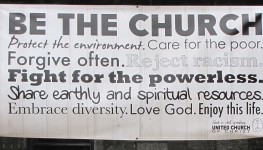
A third thing we can and must do to be better and make things better is to be the church.
Now, I want to be careful here. I don’t want to get out in front of you and suggest specific actions or statements that we haven’t discussed and discerned together. But I will suggest that we put some effort into figuring out what our role—our purpose, if you will—is in such a time as this.
Everything that has happened in our government over the past two weeks suggests to me that proclaiming good news, preserving justice, and protecting freedom will require the active, prophetic, and loving engagement of the church.
Thank God everything is not up to us—individually or as a church. I believe even now that God’s goodness and grace are at work in ways we cannot see and could not even imagine. And still . . . we know that God has anointed us and that God works through us.
If the past two weeks are any guide, the road ahead will be dangerous and challenging, discouraging and sometimes frightening or painful. We, like Jesus in the wilderness, will face temptations. We will be tempted to become angry, bitter people. We will be tempted to bury our heads and hearts in the sand and hope it all blows over. We will be tempted to think nothing we do will make a difference.
But we know better and, with God’s help and one another we can be better. When we work together to follow Jesus on the way, we will be changed for the better and then things will get better.
May it be so.