“A Humbler Power”
Matthew 21:1-11
Isaiah 50:4-9a
Philippians 2:5-11
Almost seven years ago now, when Lucio Perez had been in sanctuary here for almost 700 days, I wrote a sermon called “Blessed Are the Powerless.”
It is, as far as I know, the most widely shared, frequently reproduced and published sermon I have ever written—and this fascinates me.
It suggests to me that despite our own desires for power and control—over everything from our children’s sleep schedules to our time and our health, our finances, and our government—we want to believe there is something to be learned or gained from our lack of control. The popularity of this old sermon makes me wonder if, underneath our own strivings for power, there is a desire to be freed from the weight of responsibility.
And one day after the third No Kings day, it makes me wonder if, like the people of Jerusalem who greeted Jesus with a mix of desperation and hope, we all wouldn’t secretly love for someone to come and save us.
To do the hard work of justice-seeking, peacemaking, and community-building for us. To make everything better. To protect us from the evil that surrounds us. To protect us from the heartbreak that comes along with living. To calm our anxieties and restore some sense of normalcy.
This set of all-too-human feelings reminds me of the Israelites in their early days of liberation from the cruel enslavement of Pharaoh. Moses had led them out of Egypt and through the Red Sea and they were free at last. But their lives weren’t exactly easier. When they were in Egypt, they had at least known where their next meal was coming from. When they were enslaved, they had been relatively powerless but at least they had known the routine. When they were enslaved, they had been able to blame things on someone else.
Freedom, they discovered, was exhausting.
There was too much uncertainty, too much stress. And so they longed for the bad old days. They longed for someone who would make things clear, even if their lives were hard.
Liberation demanded something of them that they hadn’t had to use in a long time: their own power.
I wonder if this why so many Americans are willing to sacrifice their constitutional rights. I wonder if this is why they seem to be okay with roving bands of masked federal agents disappearing—or killing—their neighbors. I wonder if this is why some folks are okay with a president who brags about starting a war just because he can.
Freedom, after all, is messy. New people move into the neighborhood. Situations change. Concepts like gender and marriage and situations like job security and health care keep shifting.
Maybe the people who voted to give their power away just wanted someone to make things understandable and predictable again. Maybe they just wanted someone to save them.
I hope we are humble enough to want to understand that. I hope we are humble enough to admit the ways in which we want or need to be saved.
I want to believe that, just as there is a God-shaped hole in every human heart, there is also a mostly unrealized sense that our liberation, our healing, our wholeness, our salvation, will come in large part from acknowledging and embracing our powerlessness. And, even more important, standing with the those whose power has been denied or taken away.
Palm Sunday reminds us that this idea is central to the entire Jesus enterprise, the whole work of incarnation and God With Us.
It’s not that Jesus came to fix everything—something a good king might try to do—but that he came to be with us. That he sacrificed his power and privilege to be with us. And that he came to be with us, he came to be one of us, to show us there is another, better, humbler way to live and to find the peace, joy, love, and community we long for.
The humbler power of Jesus is not power over, but power with. The humbler power of Jesus is not power for ourselves but power for all, power for the good of all.
And Jesus shows us where this power for good comes from:
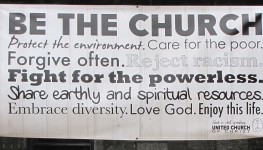
Not from accumulating, not from striving, not from claiming our privilege and doing whatever we want to get our own way—but from emptying ourselves of privilege and standing with and for the powerless.
We come into our power not by putting ourselves above others, but by standing with them. We come into our power not by acting as if we are God, but by acknowledging that we belong to the God who is love, that we are made in God’s image for love, and that—while the cynical powers-that-be would divide us for their own ends—we gain good, saving power when we realize that we are all connected and we commit ourselves to living for the well-being of all people and all creation.
This is the what Jesus was doing on Palm Sunday: using his power to bring people together. Using his power to give people hope, to awaken them to their own power, and to motivate them to use it for the good of all.
This is a humble power, and it lies in the love, mercy, and grace of God. Our power comes from the faith that God’s extravagant love is both tender and fierce, both personal and all-encompassing, and that it seeks not only our healing and wholeness but justice and joy for all.
Our strength derives from the light and Spirit of God that lives within all people. Our healing and transformation are to be found in the self-emptying love of Jesus, which allows the same mind that was in Christ Jesus to be ours.
Like Christ, we find our power by giving up, going down, and standing with. Real, life-saving, world-changing power is well-acquainted with suffering and grief, but no stranger to joy. Our liberation is collective. The way through the wilderness is found in beloved community.
We build beloved community with love. Love becomes a humble, collective power through the vulnerable of our suffering, our needs, our fears, and our hopes. And that kind of sacrificial power—the willingness to give and share and work for the sake of others—changes the world when we do it together.
This is the central message of Jesus, and the humbler power of death and resurrection, but we see it all the time, especially when we open our hearts to the powerless and when we admit that we, too, need the help of others and the love of God.
The best thing about the many No Kings demonstrations that we held yesterday, is not, in my opinion, the speeches or the singing or the clever protest signs. The best, most important, most powerful thing, I think, is the coming together as people who care about our neighbors and the world. Coming together as people committed to using our power for the good of all.
And that is what Jesus and the multitudes of seemingly powerless Jewish subjects of Rome were doing on what we now call Palm Sunday. But while we protested against would-be kings and tyrants, the oppressed people of Jerusalem wanted a king. They wanted someone to save them by fixing everything for them.
But Jesus refused to be that kind of king. Instead, he showed them and he shows us how to find our own power by living for others. He showed them and he shows us that living for others in an unjust world can be dangerous, and is likely to involve sacrifice and suffering.
For a while, the way of Jesus will look like abject failure and defeat.
But if we keep following, if we continue to lead our lives with love, we will discover new life, new power, and a fuller joy.