“A Braver Dream”
John 1:1-45, adapted to reflect the scholarship of Elizabeth Schrader Polzcer, which suggests that Lazarus had only one sister, Mary Magdalene or Mary the Tower.
Say what you will about this story, but it doesn’t pull any punches.
It is raw and real, laced with life and death, grief and loss, all of it overlaid with the uncomfortable sense that while God is surely with us in our pain, God cannot necessarily prevent it. More than that, as much as we are grateful for the promise of new life, this story makes it hard to escape the reality that getting to that newness may cost us something.
Even Jesus comes off as complicated in this story. Is he wrong, or is he brave—or maybe both? Does he let compassion be his guide, or do the feelings of people he loves take second fiddle to the glory of God? Is he learning in real time, the way all of us must, that the way of growth and new life is often paved with risk, danger, and difficulty? Are his tears and intestinal upset prompted only by his experience of Mary’s disappointment and devastation, or also by the foreshadowing of his own painful death and the grief it will bring to those who love him?
After all, Jesus’ raising of Lazarus is sandwiched between two accounts of people wanting to kill him, first for having said that he was one with God—which the religious leaders considered blasphemy—and then for having raised Lazarus from the dead, which the religious leaders were sure would rile the people up to the point of bringing the wrath of Rome down upon the temple.
I want to suggest this morning that the way of Jesus calls us to follow a braver, and sometimes costly, dream; that the way to new life will sometimes lead us through periods of pain, loss, and doubt.
The story of Lazarus and Mary shows us, perhaps more clearly than any other, that it takes courageous faith and deep trust to let something we love or depend on die for the sake of something truer and better and more authentic. To move toward healing, wholeness, and new life, we may have to let go of the habits, beliefs, and relationships that no longer serve us. To get to where we want to go and become who we’re meant to be we may have to make a dramatic course correction. We may disappoint people we love. We may lose the approval of people we love. We may make all the courageous choices only to discover that doing the right thing doesn’t necessarily protect us and those we love from pain.
The story of Mary and Lazarus challenges us to trust God through the hard times, to persevere as if we know something better is coming. At the same time, it encourages us to trust that God is with us in our pain, and to lay our pain at Jesus’ feet with a faithful demand that he do something about it.
“If only you had been here!” Mary wails to Jesus from the pit of her grief and despair.
How reassuring it is to see that Mary is unwilling to dial back her grief out of respect for Jesus or to receive cold comfort from what sounds like a promise of some-day resurrection. It’s not that she doesn’t have faith; it’s that her grief over her staggering loss in the here and now overwhelms her hope for the restoration in the sweet by and by.
If that’s not raw and real, I don’t know what is.
Never mind that Mary goes on to confess that Jesus is the Messiah, which is a very big deal. But with her brother four days buried, that liberating truth takes a back seat to her heartbreak and fear.
She says to Jesus again, “Lord, if only you had been here. Lazarus wouldn’t have died.”
The text goes on to say that Jesus begins to weep after seeing Mary and all the people with her weeping, but I can’t help but wonder if his distress and tears came also from knowing that Mary was right. Knowing that he could have healed Lazarus before he died and thus spared Mary and others great suffering. But he had chosen the path that would bring greater glory to God. Had he not realized it would also bring greater suffering to Lazarus’s family?
It seems to me that this conundrum is not unique to Jesus.
How many of us, at different points in our lives, have had to reckon with the reality that something we feel called to do or some identity we must live into will likely hurt or disappoint people we love? How many of us have faced either the risk or reality of rejection upon coming out, moving on, saying “no,” or taking a stand?
How do we weigh pain in the present against growth and healing in the future? How do we balance hurting others, even temporarily, against a greater good? How do we summon the strength and grace to make such a choice?
Episcopal Bishop Marianne Budde says we must practice being brave, we must make a habit of living in alignment with God’s values of love, mercy, and liberation so that when we are faced with a “decisive moment” we have the courage and conviction to make the right choice.
Budde says that decisive moments—those times that challenge us to make a leap of faith, stand up for justice, or do the hard and right thing—“are preceded by seasons of preparation, practice, and intention, of making countless daily decisions that determine our capacity to be brave when called upon or when we’re summoned not of our own choosing.&rdquo
“The courage to be brave when it matters most,” she says, “requires a lifetime of small decisions that set us on a path of self-awareness, attentiveness, and willingness to risk failure for what we believe is right. It is also a profoundly spiritual experience, one in which we feel a part of something larger than ourselves and guided, somehow, by a larger Spirit at work in the world and in us.”
We all have these decisive moments in our lives. Take a moment to reflect on some of those moments in your own life—maybe they had to do with a relationship, a calling, a reckoning with your own identity, a stepping back, or some other kind of change. Those were moments that called you to listen to Spirit, to trust that God was inviting you to something that would ultimately be for you, to be true to your best self and to God’s call to love extravagantly and live fully.
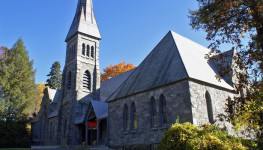
We also have decisive moments as a church.
In 2010, for example, we chose, after some internal disagreement and strong and hard feelings, to adopt an anti-racism covenant.
In 2014 we chose to spend a whole lot of money—most of which had been given to us, and the rest of which we had given ourselves—to make our building more accessible to all. Instead of choosing pretty things, instead of choosing fancy things, we chose to do what would be most helpful to our members, friends, neighbors and community members who were disabled or aging.
And on a September evening in 2017 we chose to invite Lucio Perez to take sanctuary in our building.
Those were decisive moments, and Spirit empowered us to dream bravely and make courageous choices. They were brave actions not only for the risks involved and what our choices made possible, but also because of the dreams and desires we had to let die.
In adopting our anti-racism covenant, we had to let go of the illusion that everyone was fully on board.
In choosing to use the large bequest given to us by Ben and Midge White and to focus a capital campaign on making our building more accessible, we had to let our dreams of other ministries and building improvements die, a least for a while.
And in deciding to invite Lucio to take sanctuary, we had no idea what it would cost us (spoiler alert: a lot), and still we took that huge leap of faith together.
There have been other decisive moments in our life together when the Spirit didn’t speak as clearly or loudly, when perhaps we were not as brave as we could have been. And the good news is that Spirit can work with that too, that God’s love and guidance is always with us, no matter what choice we make. The promise of new life is always before us; we are invited to choose it every day.
Sometimes it is up to all of us to make new life possible—for one person, for an entire group of people, for our community, for the world.
Amid the grief, tears, and pain of Jesus’ braver dream of raising Lazarus from the dead, there is work for everyone to do. Jesus calls the community to move the stone from the tomb. And when Lazarus walks out of the tomb alive but still wrapped in death, Jesus calls the community to do the liberating work of unbinding.
That work belongs to all of us. That work of liberating and healing is for all of us.
So let us have faith enough to choose life. Let us ask God for the strength and faith we need to make hard choices. Let us be brave enough to love without measure or condition, even when it costs us something. Let us be compassionate enough to understand and love the people who might be hurt or disappointed by our choices. May we honor their pain even as we follow our own path toward new life.
May we all be brave enough to love with all our hearts. And may we be brave enough to empower everyone to become who they’re meant to be, and to live in justice and peace.