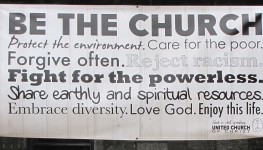
“A Wider Love”
Luke 10:25-37
Luke 15:11-24
The way of Jesus is a way of wider and ever-widening love, an active and sometimes costly love that is extended not only to people like us, not only to people we like, but also to people we consider outsiders or enemies, also to people we rarely consider as three-dimensional, complicated people like us, also to people who have hurt us and wronged us, people who abuse us and detest us.
Also, and also, and also.
These are the most familiar messages of these familiar parables, stories known not only by followers of Jesus but also by many who know nothing of Jesus or his teachings. In common, everyday discourse, to call someone a “good Samaritan” is to say they went out of their way to help a stranger in need. To refer to the prodigal son is to say that someone lost their way and hurt others and themselves, but then came to their senses and came home.
What we hear most often from these stories is that offering the wider, more compassionate, most unexpected love and mercy is something we’re supposed to do. We should love our neighbors the way the ostracized but good Samaritan does, understanding that everyone is our neighbor. We should have compassion on and forgive the people who have mistreated us the same way the parent forgives the son and celebrates his return, with the same wide and merciful love God has for us.
All of that is true and well and important and good, but when we reduce a story—any story—to shorthand, we can be pretty sure that we are giving it short shrift. When we think any gospel story is only about what we should do, we have missed the good news message of how God’s wider love can heal and transform us. When we think we know the meaning of something and have absorbed and maybe even incorporated its lessons into our lives, chances are we no longer give it much focused thought or attention.
Been there, done that, we think unconsciously.
Lent is, of course, a perfect time to bring these stories back into our conscious awareness. To reflect on them anew and ask what else they might have to teach us here and now at this moment in our lives and in the life of the broken world God so loves.
It is both a tall order and an essential labor of love and faithfulness.
On the one hand, one sermon cannot begin to adequately plumb the depths, meaning, and blessings of even one of these stories, much less both of them. On the other hand, considering both stories together invites us to see commonalities, perspectives, and big pictures we might otherwise miss.
In both stories, for example, we see that the world can be a harsh place. We see that people are often broken and that, from that brokenness, they sometimes behave badly.
This is no pie in the sky theology where long-suffering good people gain their reward in an imagined heaven; Jesus deals with reality. Even in parables, Jesus traffics with real people in relatable circumstances. Jesus invites us to see—truly see—and consider real-life circumstances where innocent people are robbed, beaten, and left for dead; where religious leaders (supposedly good people) ignore suffering; where privileged children feel misunderstood and hemmed in, and in their natural journey of becoming their own person sometimes break the hearts of those who love them, burn bridges, and make a mess of their lives.
Jesus speaks of a world where bad things happen for no good reason and pretty much everyone will, at some time or another on their life journey, do something horrible, not do something they should, or make bad choices.
But Jesus also speaks of a love that is wide and deep and high and long enough to hold it all. To heal it all. To redeem it all. A love that saves us when we receive it and heals us when we give it. A love that transforms us when we receive it and enlarges us when we give it. A love that is always there, ever available, binding everyone and everything together in tender mercy and bottomless, boundless compassion.
It is this Spirit of extravagant love that leads the Samaritan to go above and beyond in caring for the Jewish man left for dead by the side of the road. It is this same Spirit of wondrous love that prompts a brokenhearted parent to go running down the road to wrap his lost son in his arms, to start planning the welcome-home party before he’s heard a word of the son’s well-rehearsed and perhaps not entirely sincere apology.
It is this same Spirit of merciful love that holds everything together. It’s in our spiritual DNA. It’s in the air we breathe. It’s the ground on which we stand. It’s where each of us began and where we all will end.
Dust to dust. Spirit to Spirit. Love to love.
This morning I want to suggest that what these parables—and everything Jesus said and did—have in common is a holy premise.
The grounding truth behind these stories, the radical truth woven between every line of every Jesus saying, is that our hearts, our lives, our families and communities, our nation, all of creation, and everyone everywhere in all the world the whole world are held in a vast, scandalously generous love. We are held in that love and connected through that love to God and to all people and all creation.
I realize this may feel like a stretch, especially the day after our government has gone to war against yet another nation. I realize you may be wondering how Jesus or I could expect anyone to trust such an all-encompassing, steadfast, wide and deep when the world God supposedly loves feels like one big dumpster fire, when every day brings news of another law or court ruling ignored by elected officials, another law-abiding immigrant snatched from the streets, another scientific fact denied, another environmental regulation abolished, another family gone homeless and hungry, and, on some days, yet another unjust war and countless innocent civilians killed to distract us from the reality of sexual crimes committed against children.
I hear that doubt. I understand that skepticism. I honor any and all reluctance to be taken in by something that seems too good to be true.
I do.
And all I can tell you is this: The longer I try to follow the way of Jesus, the deeper I seek to go into the holy mystery that is God, the more I am convinced that our salvation—which is to say, our healing and transformation, our deliverance and liberation, and the world’s—comes not primarily from the good that we do or the love that we share but from our willingness to trust—despite all the evidence to the contrary—that the wider love of God is real and active in the world. That we are held in that love.
That it’s there, that it is for us, that there’s nothing we can do or not do to lose it, and that nothing can separate us from it. Ever.
What I can tell you is that life feels better and hope grows stronger when we can ground ourselves in the reality of that love. When we decide to trust it, even when we don’t feel it. When we give ourselves over to it fully. When we let it change us. When we live into it and live it out. When, as the resistance song says, we hold on, hold on, trusting even in the darkness that here comes the dawn.
I want to leave you this morning with what I think is a story about the love that holds us up and holds everything together, the love that is in the air and in our DNA. It comes from an Instagram account called “thewaywemet,” and it goes like this:
I accidentally Venmo’d a stranger $847 last year. Meant to send it to my roommate Jake. Sent to to a random Jake instead. Panicked. Messaged him: “Wrong person! Can you send it back?” He replied: “I can’t. I already spent it. Groceries for my kids. Power bill. I’m sorry. I’ll pay you back. I promise. $50 month. It’ll take me forever but I will.” I was furious. That was my rent. Then I looked at his profile. Single dad. Three kids. Every transaction: “School lunch” “diapers” “medicine”
Sat there staring at his Venmo history. All going out. Nothing coming in. Living paycheck to nothing. My $847 mistake was his miracle. I replied: “Keep it. Just promise me something. When you’re stable, do this for someone else. Pass it on.” He sent back: “Why would you do this?” I said: “Because I can miss $847 for a month. You can’t miss feeding your kids for a day. That’s the difference.” He replied: “I’ll never forget this. Ever. I promise I’ll pass it on.”
Forgot about it. Eight months later, got a Venmo notification. Jake sent me $847. With a note: “I got promoted. Here’s your money back. Plus $135 extra. Because you didn’t ask for interest but you deserve it. You saved us. Thank you.” I sent it right back. ”Keep it. Remember the promise? Pass it on.” Two weeks later he messaged: “I found someone. Single mom at my work. Behind on rent. Sent her $1,000. Told her the story. Told her to pass it on when she can.”
That was a year ago. Last week I got a weird Venmo. $50 from someone I don’t know. Note said: “You don’t know me. But Jake helped my mom. She told me about you. About the $847 mistake. I just got my first paycheck. I’m passing on $50. To someone who needs it. Because you started something.” I cried. My mistake started a chain. Sent her back: “Who’d you send it to?” She replied: “College kid. Can’t afford textbooks. I told him the story. Told him to pass it on.”
Started tracking it. Asked Jake to connect me with people in the chain. There were 23 people. All linked by Venmo and the same promise. “Pass it on when you can.” Amounts vary. $50. $200. $1,000. One guy sent $15. … They’ve helped each other with: rent, medical bills, car repairs, groceries, school supplies. A whole network of strangers. Connected by one $847 mistake.
The 23 people started a group chat. Called it “The 847 Chain.” They share when they’re struggling. When they’re stable. When they pass it on. Last month someone posted: “Lost my job. Scared.” Within an hour, three people sent money. Unsolicited. Just: “You’re in the chain. We’ve got you.” That person is stable now. And last week sent $300 to someone else in the group. The chain doesn’t break. It circles. Everyone gives when they can. Receives when they can’t.
Yesterday got a message from someone not in the group. “I heard about the 847 chain. Someone helped me who was in it. They told me the full story. I want in. Not for money. Just to be part of people who show up for strangers.” The chain is 47 people now. …Because one accidental Venmo taught us: money’s just money. Until it’s someone’s rent. Someone’s food Someone’s hope.
Jake messaged me last week: “… The 847 Chain just hit $28,000 total passed on. 47 people. 28 grand of kindness. Because you made a mistake and chose grace over anger. You could’ve demanded it back. Could’ve reported me. Instead you changed 47 lives. Including mine. My kids ask about you. ‘The person who helped daddy.’ I tell them: strangers aren’t strangers if you choose to see them.”
Beloveds, this is the wider love of the Jesus way. It will change us and the world if we let it. If we follow in the way. If we trust that the love is there. If we choose to see the strangers in our midst. If we choose to forgive those whose brokenness has hurt us. If we pass on the love and mercy we have received.
May it be so.