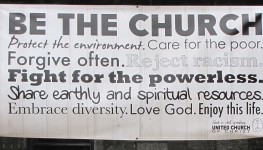
“Everyone Belongs”
Luke 4:1-13
an excerpt from “My Parting Prescription for America”
Lent is a holy season, so holy that some folks seem to think joy is not allowed, that repentance and confession and forgiveness and following Jesus to the cross is dead-serious business. Other people seem to think that, given the state of the world, the ongoing destruction of our democracy, and the loss of countless jobs and lives to the whims of the current administration, this is no time for coddling or comfort.
So . . .
While noting in passing that the word comfort means to fortify with kindness (and who among us doesn’t need that?), I’m going to begin this first sermon in the wonderful season of Lent with some excerpts from a new children’s book—because it is easier for us to receive the biggest, most important truths at a child’s level.
So, please pretend you’re sitting in your favorite person’s lap, and settle in:
“Is there anything more cozy than the feeling of belonging?” asks the Book of Belonging, a collection of Bible stories for kids. “The Bible is filled with stories of God telling God’s people, ‘You belong with me!’ No matter how lost or lonesome we feel, there is always a place for us with God.”
“Love,” the book continues, “is the most powerful force in the universe. It is bigger and deeper and brighter than we can understand. Beloved is really just a fancy way to say, ‘Someone Who Is Loved.’ … Here’s something pretty amazing: God loves people so much that God says each and every one of us should have this name. Beloved Me, Beloved You, Beloved Us. We are all Beloved.”
The book goes on to explain that because God knows our true names, God’s love for us never ends. No matter what, God always says:
I belong with you, and you belong with me.
Nothing can stop my love.
I will love you when you turn away from me.
I will love you when you hurt one another.
I will love you when you harm the earth.
I will love you when you
believe untrue names for yourself.
I will love you when you believe untrue names for me.
And I will love you when you forget me.
Let that sink in for a moment. Notice how you feel. Give your inner child a long, loving hug.
I don’t know about you, but when I was a child, no one told me those things—about God or myself. Truth is, I got some very different messages—messages that I’m still healing from. Maybe you did, too.
May our inner children know themselves loved and cherished.
Now, imagine if every child on earth grew up hearing and believing that they belong and are beloved. Imagine with me how different our lives and the whole world might be if the people in power knew and believed that everyone belongs. That everyoneis loved and precious.
Know that this always has been and forever will be God’s dream for us, all people and creation, and all the world: everyone healing and whole, everyone beloved and belonging, everyone seen and cherished as God’s very best work.
I could say something here about all the reasons most people don’t get those messages. I could include all the harmful messages we’ve received instead, noting that many of them came from the church. I could then move on to naming some of the many injustices and places of brokenness and despair that exist in large part because so many people have not heard or refuse to believe that everyone belongs and everyone is beloved.
We could talk about some of that—and maybe we will talk about it at today’s Lenten Lunch—but for now I want to focus on attuning our hearts and minds to the radical truth of belonging and belovedness.
Because while we can say and do all the inclusive, welcoming, boundary-crossing things, if we don’t truly believe in our heart of hearts that everyone belongs, nothing will change. If we don’t truly believe in our hearts that we belong, we will not heal and grow. And if our image of God is not all-loving and all-cherishing, it will be difficult for us to understand how to develop and practice our own spirituality of belonging.
Now, you may be thinking that “belonging” is a ridiculously warm and fuzzy thing to be focusing on while the world is on fire and the United States as we have known it seems to be in its final season. When so many destructive things are happening every single day and so much more is threatened with destruction, moral outrage is a reasonable response.
Moral outrage is both reasonable and justified and, besides, it makes us feel better—or at least a little bit less awful and a little bit more superior. And so we’re tempted to spend our precious time and energy reacting to all the horrible things “they” are doing.
“Can you believe that Elon Musk believes our fundamental problem as a society is empathy?!?” we might say.
Can you believe how Donald Trump acts like he’s king of the world, ignoring the Constitution and the Congress and ordering entire nations around as if they’re pieces on a chessboard?!?
Oh, I get it. Believe me.
But what if, as Gregory Boyle says, God is calling us away from moral outrage and toward seeing goodness, toward the kind of love that heals and helps create a culture of “cherished belonging” that includes every single person on the planet?
What if we, ourselves, were so transformed by the God who is love that we were able not only to accept everyone, but also prize them?
What if God loves us, heals us, lifts us up, and sets us on our feet “not just to stand” in the strength and love of God, but also “so that we can move forward and walk each other home?”
What if we, like Jesus, we were able to look beyond and beneath all the harmful behavior, unjust policies, ongoing racism, unchecked power, all-consuming greed, and shocking cruelty run amok in the world and see all the underlying hurt, to find the deep spiritual and emotional wounds that are in need of love and healing?
What if we could change the world by letting love heal us and by creating communities and places of unquestioning, life-changing belonging?
What if we got so serious about the love of Jesus that the Spirit could help us see and cherish every person—no exceptions—with the eyes and heart of God?
What if Jesus of Nazareth, famished and lonely after spending a long time praying and fasting in the wilderness, was able to resist the evil one’s temptations not primarily because he knew lots of scripture, but because he was grounded and whole and living in God? Could it be that Jesus didn’t view the devil as an adversary but rather as yet another being who was living in pain, another being who’d been hoodwinked into thinking life was all about money, power, and invincibility?
Could it be that compassion (as yes, empathy)—for ourselves, others, and all creation—is the doorway to wholeness, belonging, and beloved community, and that those things might make justice and peace the norm rather than a constant struggle?
“Systems change,” says Homeboy Industries founder and Jesuit priest Greg Boyle, “when people do.” And “people change when they are cherished.”
Homeboy Industries bills itself as the world’s largest gang-intervention, rehabilitation, and re-entry program.
Which is to say: Greg Boyle knows a thing or two about cherishing people that every system in our society has labeled, isolated, punished, incarcerated, and written off. He is able to do this, and to create entire systems devoted to cherishing and healing those society has spurned, because he believes that “everyone is unshakably good (no exceptions)” and that “we belong to each other (no exceptions).”
And if your morally upright self bristles at that all-inclusive cherishing and immediately begins making a mental list of people who surely are not “unshakably good,” (a) wait until you hear what he says about God, and (b) I hope you’ll read his latest book or at least join us for more discussion at our Lenten Lunches throughout the season, where we’ll also be discussing Dr. Vivek Murthy’s “Parting Prescription for America,” which boils down to community-building.
“We live in a wounded and wounding world,” Boyle says. “And loving the wounded is never wasted effort. Only love makes progress.”
Together this Lent, let’s begin building a community of cherished belonging. Together, let’s focus less on changing people’s minds and more on healing their wounds—and our own.
Because everyone belongs. Everyone. No exceptions.