“Life Re-Imagined”
John 20:1-18
I know, I know: It’s. The. Same. Old. Story.
The same old, hard-to-believe story that we’ve heard countless times before, sometimes desperately wanting to believe, other times refusing to believe, and occasionally, if we’re honest, treating this story like some kind of holy fairy tale: That if we just close our eyes, click our heels together three times, and say the magic words—Alleluia!—the tomb will be empty, Jesus will have risen, all will be right with the world, and we’ll feel better about things.
Alleluia! Yay, God!
The story itself doesn’t promise any of that, of course. Easter is not about putting on a happy face, whistling in the dark, or otherwise denying the reality that death is real, unjust crucifixions happen every day, and life can be hard.
What the story says, whether we believe in the bodily resurrection of Jesus, a metaphorical resurrection, or none of the above, is that nothing—neither the crushing power of empire nor the abject fear of humanity, neither our closed hearts nor our lack of imagination—could keep Jesus dead.
What the story says is that death is not the end, that whatever looks like the end may, instead, be a new beginning. What the story says, I think, is that nothing is stronger than God’s love.
Of course, it’s not actually the same old story—because we’re not the same old people. Never mind that we’re not the same people we were the first time we heard this story; most of us are not the same people we were when we heard this story just last year!
So much has happened since then. So much has been lost.
We may come to this second pandemic Easter needing the hope of resurrection more than ever before and finding that hope harder than ever to believe and receive.
Maybe you come to this Easter morning much like Mary Magdalene came to the tomb so long ago: heartbroken, devastated, alone, wallowing in grief, having no expectations whatsoever, just wanting to find some comfort from being near her savior’s body. She went while it was still dark.
If that is where you are this morning—casting about in the darkness and uncertainty of pandemic time for any source of comfort, groping in the darkness of your weary heart for a reason to go on—God bless you!
God sees you, we see you, and our Healer God longs to restore and renew your broken-open heart. May you know the courage and power that come from just showing up and putting yourself in the path of the light.
Whenever we continue to show up, whenever we are willing to be present to places of pain and death, defeat and despair, we will find ourselves—if not our circumstances—changed. We will be transformed, if not completely healed. We will discover meaning and purpose and community, if not instant victory.
Or maybe you come to this Easter morning feeling as though you are the one who’s been in the tomb—not for just three days but something closer to 385. More than a year’s worth of days. Maybe you’ve stuck one foot out of your isolated pandemic bubble many times, maybe you’ve allowed yourself to begin to hope—only to have to bring that foot in back in when there’s another surge in coronavirus cases or when another important life event is canceled, only to have your despair resurface when another Black person is killed by police, or when the challenge of working and homeschooling and caring for others becomes too much. Maybe your stinky, over-crowded bubble has begin to feel like a tomb, and you’re wondering if the fullness of life you once took for granted will ever be restored.
If you come to this Easter morning from the darkness of your own tomb—God bless you!
God sees you, we see you, and our Liberator God longs to deliver you from captivity. May you know the transformation and strength that come from dying to what was and keeping the seed buried in the ground until new growth begins to sprout. May you know that you are not dead, but are, instead, doing the important work of transformation and reimagining what life can be.
Which brings us back to our old, ever-changing story of Jesus and new life.
After Mary discovers the tomb to be empty and runs to tell the male disciples; after more running and then confirmation by two male disciples that the tomb is, indeed, empty; after the male disciples consider this and then go home; Mary remains outside the womb, weeping. Someone has added insult to her injury; as if killing Jesus were not enough, now they have taken his body. She is so distraught that even angels do not help.
But then an interesting thing happens. Jesus appears, but Mary does not recognize him. It is not until he tenderly speaks her name that Mary realizes who he is.
On one level, this is not surprising. We all know that death, loss, and other struggles and griefs change us. But the Easter story suggests that the change Jesus has undergone over three days is more than internal; he does not even look the same.
This makes me think that Easter is about far more than life and love conquering death and evil, that resurrection is about more than getting back to so-called normal.
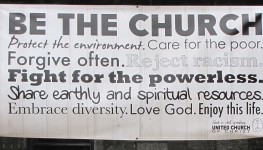
In Easter, and through the human body and life of Jesus, God invites us, God calls us, not only to new or restored life but also to life reimagined. Life as it is meant to be. For everyone.
At Easter, God invites us to reimagine life so that instead of a survival-of-the-fittest world where each person (and their privileges) are on their own, we create a world where we are bound together in love, and we all care for one other.
God invites us to reimagine lives governed not by fear, anxiety, and enmity, but by trust, solidarity, forgiveness, and love.
In the new, reimagined post-Easter life, we are not competing against everyone else for a scarcity of goods, but sharing our God-given abundance so that everyone has enough.
Instead of exclusion, there is extravagant welcome for all, the celebration of our differences, and belonging that transforms hearts.
Instead of the frantic pursuit of some glamorized ideal of individual happiness, the Easter movement reimagines and facilitates a shared commitment to gratitude and joy.
I could go on—reimagining a world where the last are first, where the poor are blessed and the meek inherit the earth, where assault rifles are beaten into plowshares, the lost are found, and the least and the left-out are made the center of things—but you get the idea.
Jesus did not live to leave us as we were. Jesus did not die so that things would stay the same. And Jesus was not raised to leave more room in the tomb for us. Resurrection is not primarily about life restored but about life transformed.
“Do not try to hold on to the way things were,” the Risen Christ tells Mary Magdalene. “I am going on ahead, and there is new life for you and for all. Another world is possible.”
Christ doesn’t say the reimagined life will be easy. We keep praying “thy kingdom come” because it’s not yet here. But Christ does promise to be with us, always. He fills us with Spirit power and tell us that, with God, nothing is impossible. He charges us to love one another as he has loved us, and beckons us to follow him on the self-giving path to new, reimagined life.
On this Easter morning, some 2,000 years after the first Easter, the tomb is empty and the path is clear. On this Easter morning, the 53rd anniversary of the assassination of the Rev. Dr. Martin Luther King Jr., death still dares us to reimagine life.
“In my dream,” says the artist Brian Andreas, “the angel shrugged & said, If we fail this time, it will be a failure of imagination. & then she placed the world gently in the palm of my hand.”
Beloveds, Christ is risen. He is risen, indeed.
Let us also rise to new, reimagined lives, that we might shout for joy:
Alleluia! Yay, God!